Posts from the ‘Writing’ Category
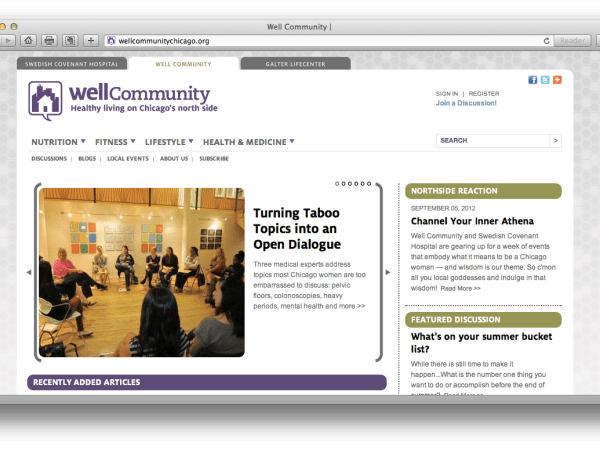
Three medical experts address topics most women are too embarrassed to discuss
You probably know people who’ve thrown out their back or pulled a hamstring, but did you know it’s possible to throw out your pelvic floor muscle?
That little nugget was one of the many fascinating facts gleamed by attendees at a Girl Talk: Shhhh! Ten Taboo Topics event on Thursday night, where participants had the opportunity to bring up health concerns they may otherwise keep to themselves. The women wrote down anonymous questions that were answered by a panel of medical experts. The event was part of Swedish Covenant Hospital’s Wise Woman Week and took place at Flourish Studios.
The discussions about pelvic health didn’t stop at muscle pulls; the women—most of whom were meeting for the first time—delved into details about incontinence, bowel control, sexual function and beyond. The evening’s panelists, women’s health physicians and specialists, fielded the questions with ease and not so much as a blush.
“It’s just like any other muscle,” said Dr. Shameem Abbasy a urogynecologist at Swedish Covenant Hospital who specializes in pelvic floor disorders. “If you injure it or have problems, like leaking urine, there are pelvic floor physical therapists who can help.”
She explained to the group that three sets of 12 Kegel exercises daily may help to strengthen the pelvic floor muscles. But she warned that it is very important to work the right muscles during the exercises.
“I often see patients who are pushing and straining when doing a Kegel, and that’s not what you want to do,” Dr. Abbasy said.
For more advanced pelvic floor muscle training or help activating the right muscles, she recommended the Total Control class at Galter LifeCenter or making an appointment with a urogynecologist or pelvic floor physical therapist.
From there, the group’s conversation transitioned to digestion concerns and periods.
Dr. Kavita Singh, a gastroenterologist at Swedish Covenant Hospital, fielded questions about Celiac Disease, colonics, colonoscopies, constipation, hemorrhoids, Irritable Bowel Syndrome and functional bowel disorders. She explained that all of these conditions are very common among women and nothing to be embarrassed about.
For people worried about discomfort during a colonoscopy, she emphasized that this life-saving procedure is worth a few hours (or days) of possible cramping afterward. The procedure is an examination of the colon and the opportunity for polyps growing in the colon to be removed.
“One-third of the population makes polyps, but there are no symptoms,” she said. “You can have a large polyp in early or advanced stage cancer and never feel it.”
She recommends a first colonoscopy at age 50 unless there is a immediate family history (parent, grand-parent, or sibling) of colon cancer, in which case you should begin at age 40 or 10 years earlier than when your relative was diagnosed—whichever comes first.
Regarding the increasingly trendy colonic procedure, Dr. Singh recommended staying away from them. “I don’t recommend colonics because the body already has a natural method for cleaning itself in one specific direction.”
When asked about methods to lessen or control heavy bleeding during a period, Dr. Abbasy discussed endometrial ablation, a procedure where the uterus lining is thinned.
“It’s a good option for people who don’t want to undergo a full hysterectomy,” said Dr. Abbasy.
Treating the Mind and Changing Behaviors
With many bodily functions and concerns covered, the conversation switched to a topic that women too often ignore: mental health.
Dr. Julia Rahn, a psychologist and owner of Flourish Studios, addressed questioned about Bipolar disorder, “crazy thoughts,” depression and the therapy process.
She encourages people feeling anxious or experiencing insomnia to start with a few minutes of writing and deep breathing.
“Take a journal, don’t edit yourself, get it all out,” she said. “Most people immediately feel better once they’ve done that.”
If a person wants to explore counseling or therapy, Dr. Julia recommended looking for a therapist who will “listen and recommend changes,” and not one that insists on “telling you what to do.”
Missed the Event? No problem.
Dr. Abbasy and Dr. Singh host talks like this two-to-three times a year to grateful crowds, so watch for updates about future Taboo Topic events.
Participant Danielle Washington of Lakeview appreciated the “free forum to ask anything and not feel judged.”
Her friend Jasmine Sayeh of Lakeview said she was leaving the event with “lots of good information.”
Flourish Studios is a multi-faceted learning gallery in Lincoln Park, which motivates and prepares adults, teenagers, and children to bring about significant, self-selected life changes.
Heidi Lading is a freelance writer in Chicago.
Photo credit to Heidi Lading

In today’s economy, understanding and implementing creative ways to stretch your dollar is almost a necessity. I’ve never shied away from asking for a better deal than what’s offered to me, but I realize not everyone suffers from my own brand of inflated self-confidence. My interest in writing about this topic sprung from a desire to encourage others, women especially, to mine for the unexpected opportunities in everyday life to save money. [Warning: this advice may trigger addictive behavior. Once you save money the first time, you’ll want to do it again and again and again!]
+++
Don’t Pay Full Price! Rebel By Negotiating
By Heidi Lading
 |
| Image: Stuart Miles / FreeDigitalPhotos.net |
There are certain bragging rights we women earn and take pride in when we snag an item at an unbelievable sale price. But the pleasure of creating your own sale price on the spot is even more euphoric. Like a sudden drop on a roller coaster, it takes your breath away. And the best part is, anyone can experience it. All you need is a little rebel negotiating.
I recently spoke with author Jessica Miller about negotiation strategies because I knew she’d give some great advice. Miller, a commercial real estate agent for Cushman & Wakefield, is also co-author of the book “A Woman’s Guide to Successful Negotiating: How to Convince, Collaborate, and Create Your Way to Agreement.”
You Don’t Get What You Don’t Ask For
The three keys to success in Miller’s book: be confident, be prepared, and be willing to walk away, are critical in negotiations. But step one is gathering the courage to ask.
“Practice is really the best advice I can give,” said Miller. “The more you do it, the more comfortable you’ll be and the more confidence you’ll have.”
Oak Park resident Kelly Rogala cut a deal on a $130 pair of jeans at a jeans party thrown by the owner of a Roscoe Village shop.
“I told him I’d give him a hundred bucks cash and he was like ‘okay’, ” said Rogala. One of her friends paid full price, 23 percent more than Rogala, for the same pair of jeans that night.
Rogala hit on two important strategies, according to Miller. First, she paid with cash and helped the store avoid credit card fees.
“If it’s a small business it makes a huge difference,” said Miller.
Rogala also spoke with someone authorized to negotiate. In this case it was the store owner, but managers or even sales associates often have the authority to grant discounts.
When I lived on the West Coast and started laser tattoo removal treatments, I negotiated multiple discounts with the dermatologist’s office manager. I paid for a package deal upfront in cash and agreed to write a testimonial of my experience and allow them to take pictures of my progress for marketing purposes. I saved 28 percent more than if I paid for each treatment separately.
There’s Strength In Numbers
Miller often negotiates “for sport” and was once in a department store with three boxes of expensive shoes in her hands. After spending a good amount of time with the salesclerk, she established a rapport with him and requested a discount for buying the three pairs. His first response: “No.” Then he tried to get her to open a credit card. She declined. When she told him she might only buy one pair that day and go home and think about the others, or buy them online—it was clear, she meant it.
Ultimately, Miller left the store with three discounted pairs of shoes. One of those boxes bore the name Christian Louboutin. She credits both the willingness to walk away and the relationship with the clerk for her success, “he had the authority to [give me a discount] and the desire to do it because he liked me.”
Adding on a service is another great way to stretch your dollar. A friend of Roscoe Village resident Kathleen Katz wanted to pay a new babysitter between $10 and $14 per hour. The babysitter wanted $15. Katz advised her friend to offer $12 and ask the sitter to do the laundry. The sitter agreed to do the laundry, clean up and watch the kids for $14.
Timing Is Everything
On a recent trip to the Southeast, Jennifer McFee of Lakeview checked into a hotel after 9 p.m. The front desk attendant stated the nightly rate and McFee offered 10 percent less. The clerk obliged. A discounted room puts more money in the till than an empty room.
Miller also advises negotiators to consider the time of year. Managers who are judged on sales and are nearing the end of a quarter might be willing to come down in price.
Use The Competition To Your Advantage
Today’s smartphones and apps allow for instant price checking. Miller encourages buyers to “use that as a legitimate argument for why you think something should be priced different.”
She warns sometimes the manager may suggest you go buy the product elsewhere, but many stores today have a price-match policy. All you have to do is ask.
Mentioning the competition worked for me when I moved back to Chicago and needed a dermatologist to finish removing my tattoo. My Chicago doctor charged more than I was used to paying. When I told him my previous treatment rate he immediately cut his fee by $50 each appointment.
Be Rebellious But With A Smile
So now you know many of the secrets to rebel negotiating. One final piece of advice: when you ask for a lower price, do it with a smile. See how much further that gets you.
For more of Jessica Miller’s tips on negotiating, check out her soon-to-launch website. www.stopcompromising.com
Heidi Lading is a freelance writer in Chicago. She loves negotiating the best deal possible and encouraging her friends to do the same. Follow her at www.heidilading.com or on Twitter @iamheidi.
Click here to read “Don’t Pay Full Price! Rebel by Negotiating” at RebelliuosMagazine.com
Tell me. What’s your biggest victory when it comes to everyday rebel negotiating?

Well Community was an online news magazine and discussion forum specifically focused on health and wellness in several North side of Chicago neighborhoods. It ceased publication in 2014.
They asked me to observe a class, helping prepare young children to become big brothers and sisters, and then write an article about how to make this an easy transition for the children.
Here’s what I learned…
Preparing kid #1 for baby #2

Nicoleta Molnar shows her 6-year old daughter Emma how to hold a baby at a recent event at Swedish Covenant Hospital.
When Nicoleta Molnar and her husband told their only child Emma that she was going to be a big sister, they weren’t quite ready to take the exciting news public. The three-year-old had other plans.
Emma was so excited, she began announcing to the world, “Mama has a baby in her belly!”
“Our mistake was to tell her before we told anybody else,” said Molnar, laughing as she recalled her daughter’s enthusiasm.
Emma’s reaction reminded the Molnars that, although they have been through pregnancy, childbirth and new parenthood before, they now face a new challenge: preparing a child for a new baby brother or sister.
Parents often have questions about the right way to introduce older kids to a new baby and siblinghood. Because every family and child is different, to tackle these questions Well Community called on the experts: local childbirth educator Kim Wilschek, RN, CCE, and family medicine physician Dr. Marina Claudio, both of Swedish Covenant Hospital.
When do I have the big sister talk?
There is a lot to do in the months and weeks before your new baby is due, but talking to your older kid (or kids) about the new baby and their role as a big brother or sister should be a priority during this time.
“It’s really important to make [the child] realize from the beginning that this is their baby too,” Wilschek said, noting that there is no “best” time for this.
Cameron and Linnea Johnson made the moment special for their daughters Gwen and Sonja, ages 5 and 3, by wrapping up some baby things and letting the two girls open the gifts to reveal they were going to be big sisters.
“It’s really less about the child’s age and more about their emotional maturity,” Wilschek said. “Certainly when they start seeing changes in their mom you need to have a discussion with them about what’s going on.”
What should I teach my child?
Involving your kids in the care for a new baby is the best way for them to feel important and useful as a big sibling.
Wilschek recently taught a “Big Brother / Big Sister” class at Swedish Covenant Hospital for expectant parents and their 3-8 year-olds, where kids could learn some of the basics of helping out with a new baby.
Nicoleta Molnar and Emma were in attendance. During the event Emma practiced holding a baby doll, learned to change a diaper and decorated a onesie for the new baby.
These activities, as well as learning to feed the baby, and play during tummy time, mimic healthy adult behaviors and can give an older sibling a sense of responsibility for the new baby.
What activities should I do with my child?
Keeping your child involved doesn’t require doing anything out of the ordinary.
“In fact, focus on the ordinary,” Dr. Claudio said, using regular doctor’s appointments as her favorite example. “The newborn’s doctor appointments should happen as a global family visit.”
She explained that during check-ups, the medical focus is on the baby, but the whole family can learn about each other. This is also an opportunity for the doctor to observe the family dynamic and better understand how to help if concerns arise.
Additionally, Wilschek and Dr. Claudio both recommend parents talk to the older sibling frequently about how the child is feeling.
“It’s surprising how much [children] open up when you ask them what they think,” said Wilschek.
What if my child isn’t excited about being a big sibling?
“We know that kids change their minds—a lot,” Wilschek said. She advises parents to back off the issue if the child isn’t excited about the new baby and reintroduce the topic a little later.
Gwen and Sonja’s reaction to baby sister Naomi, 10 months, was “one of true love and acceptance into the family,” Johnson said, “But the novelty of having her around quickly wore off.”
Originally Gwen, had an interest in holding and trying to nurture the baby, while Sonja showed no interest. Today, their levels of interest and involvement have flipped.
If a child seems upset by the idea of a sibling, Dr. Claudio recommends addressing any negative feelings immediately so they do not escalate. She recommends reassuring the older child and keeping them involved so they understand that this change is a good thing.
If more serious concerns come up (like hitting or biting from the older child), Dr. Claudio urges families to discuss this with their family doctor immediately, as they will likely have ideas and resources that may help.
A few ideas and activities to smooth the transition for kids:
• Gifts — Let your child pick a special present for the baby that’s just from him/her.
• Read — Pick one or two of the many “I’m-going-to-be-a-big-brother/sister” books, and read them with your child
• Record — If your child is old enough, help him or her record themselves reading a favorite book to the new baby
• Help — Allow your child to help set up the nursery and offer suggestions for the baby’s name
• Bring — Siblings-to-be should tag along on your prenatal doctor’s appointments so they can learn what’s happening with the baby
Heidi Lading is a freelance writer in Chicago and the youngest of three children. Her older brother once dressed her up in football pads and used her as a tackling dummy. Occasionally she was allowed into her older sister’s room to play with her sister’s Barbie dolls.
Photo credit to Heidi Lading.


 Heidi (Lading) Kiec, Freelance Corporate Copywriter