Posts tagged ‘Published Writing’
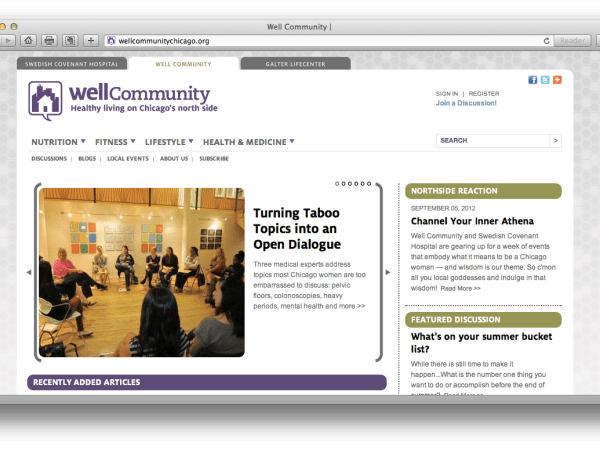
Three medical experts address topics most women are too embarrassed to discuss
You probably know people who’ve thrown out their back or pulled a hamstring, but did you know it’s possible to throw out your pelvic floor muscle?
That little nugget was one of the many fascinating facts gleamed by attendees at a Girl Talk: Shhhh! Ten Taboo Topics event on Thursday night, where participants had the opportunity to bring up health concerns they may otherwise keep to themselves. The women wrote down anonymous questions that were answered by a panel of medical experts. The event was part of Swedish Covenant Hospital’s Wise Woman Week and took place at Flourish Studios.
The discussions about pelvic health didn’t stop at muscle pulls; the women—most of whom were meeting for the first time—delved into details about incontinence, bowel control, sexual function and beyond. The evening’s panelists, women’s health physicians and specialists, fielded the questions with ease and not so much as a blush.
“It’s just like any other muscle,” said Dr. Shameem Abbasy a urogynecologist at Swedish Covenant Hospital who specializes in pelvic floor disorders. “If you injure it or have problems, like leaking urine, there are pelvic floor physical therapists who can help.”
She explained to the group that three sets of 12 Kegel exercises daily may help to strengthen the pelvic floor muscles. But she warned that it is very important to work the right muscles during the exercises.
“I often see patients who are pushing and straining when doing a Kegel, and that’s not what you want to do,” Dr. Abbasy said.
For more advanced pelvic floor muscle training or help activating the right muscles, she recommended the Total Control class at Galter LifeCenter or making an appointment with a urogynecologist or pelvic floor physical therapist.
From there, the group’s conversation transitioned to digestion concerns and periods.
Dr. Kavita Singh, a gastroenterologist at Swedish Covenant Hospital, fielded questions about Celiac Disease, colonics, colonoscopies, constipation, hemorrhoids, Irritable Bowel Syndrome and functional bowel disorders. She explained that all of these conditions are very common among women and nothing to be embarrassed about.
For people worried about discomfort during a colonoscopy, she emphasized that this life-saving procedure is worth a few hours (or days) of possible cramping afterward. The procedure is an examination of the colon and the opportunity for polyps growing in the colon to be removed.
“One-third of the population makes polyps, but there are no symptoms,” she said. “You can have a large polyp in early or advanced stage cancer and never feel it.”
She recommends a first colonoscopy at age 50 unless there is a immediate family history (parent, grand-parent, or sibling) of colon cancer, in which case you should begin at age 40 or 10 years earlier than when your relative was diagnosed—whichever comes first.
Regarding the increasingly trendy colonic procedure, Dr. Singh recommended staying away from them. “I don’t recommend colonics because the body already has a natural method for cleaning itself in one specific direction.”
When asked about methods to lessen or control heavy bleeding during a period, Dr. Abbasy discussed endometrial ablation, a procedure where the uterus lining is thinned.
“It’s a good option for people who don’t want to undergo a full hysterectomy,” said Dr. Abbasy.
Treating the Mind and Changing Behaviors
With many bodily functions and concerns covered, the conversation switched to a topic that women too often ignore: mental health.
Dr. Julia Rahn, a psychologist and owner of Flourish Studios, addressed questioned about Bipolar disorder, “crazy thoughts,” depression and the therapy process.
She encourages people feeling anxious or experiencing insomnia to start with a few minutes of writing and deep breathing.
“Take a journal, don’t edit yourself, get it all out,” she said. “Most people immediately feel better once they’ve done that.”
If a person wants to explore counseling or therapy, Dr. Julia recommended looking for a therapist who will “listen and recommend changes,” and not one that insists on “telling you what to do.”
Missed the Event? No problem.
Dr. Abbasy and Dr. Singh host talks like this two-to-three times a year to grateful crowds, so watch for updates about future Taboo Topic events.
Participant Danielle Washington of Lakeview appreciated the “free forum to ask anything and not feel judged.”
Her friend Jasmine Sayeh of Lakeview said she was leaving the event with “lots of good information.”
Flourish Studios is a multi-faceted learning gallery in Lincoln Park, which motivates and prepares adults, teenagers, and children to bring about significant, self-selected life changes.
Heidi Lading is a freelance writer in Chicago.
Photo credit to Heidi Lading

Well Community was an online news magazine and discussion forum specifically focused on health and wellness in several North side of Chicago neighborhoods. It ceased publication in 2014.
Dining & Dishing about Health

Well Community was an online news magazine and discussion forum specifically focused on health and wellness in several North side of Chicago neighborhoods. It ceased publication in 2014.
Medical must-haves for travel with kids
A local pediatrician’s tips and basic first-aid supplies may be the most important items you pack for your family trips this summer.
Summer is officially here, along with the busy season for family vacations.
Unfortunately not every vacation will go as planned. Illnesses or injuries can come up, especially when traveling with babies and small children. But taking certain precautions can put your mind at ease and help ensure the most enjoyable vacation possible.
Dr. Nisha Vijay, a pediatrician at Swedish Covenant Hospital, knows first-hand what it’s like to watch a child suffer with illness while away from home. She traveled to India with her twins when they were just 18-months-old. During the trip both children developed diarrhea and started vomiting.
“It was very bad. The diarrhea was five or six times a day,” said Dr. Vijay.
She immediately replaced regular milk with soy milk, ceased any sugary drinks and gave them thickening foods like rice, bananas and toast. She also made sure they were drinking enough water to stay hydrated.
Soon the twins were back to normal.
Although Dr. Vijay’s training as a physician helped her know what to do, she explained that any parent can defuse a stressful health situation with just a few first-aid essentials and health-related travel tips.
First-aid essentials for every destination
No matter what kind of trip you have planned this summer, Dr. Vijay advises you bring the following:
- Contact information for your pediatrician or family medicine physician
- Immunization records and insurance information
- Oral liquids: acetaminophen (it doesn’t have to be Tylenol), ibuprofen and Benadryl
- Topical ointments: Benadryl cream and a one percent hydrocortisone cream
- Antibiotics: any over the counter antibiotic, such as neomycin
- Anti-fungal cream
- Bug spray and sunscreen
- Probiotics to regenerate good bacteria
- Tweezers (for removing splinters or bee stingers), nail cutters and band-aids
- If your child has severe allergies, make sure you have two EpiPens on hand
- If your child has asthma, make sure you carry a nebulizer or an inhaler
- If your child is currently on medication for seasonal allergies or anything else, make sure you have enough of it on hand, and bring along a refill too.
- Lots of snacks and bottled water (you never know when you’ll be stranded)
Enjoyable air travel
Older kids know to swallow during take-off and landing to prevent ear pain, but for babies and toddlers Dr. Vijay recommends breast feeding, a bottle or sippy cup, or a pacifier during these moments.
“Something for them to chew or suck on will help with the ear pressure,” she said.
If you are worried the child will have difficulty being constrained to the seat during a long flight, she suggests giving them a dose of Benadryl before the trip. However, you should test this at home well in advance of the trip to see how the child reacts.
“Some kids have a paradoxical reaction to Benadryl and it makes them hyper,” Dr. Vijay said, adding that you should keep ibuprofen or Tylenol in your purse or carry-on in case the child develops a fever in flight.
All the medical precautions aside, her number one must-have for plane travel is lots and lots of kid-friendly snacks.
Open water adventures
If your vacation involves a cruise ship, Dr. Vijay said the most common ailment will likely be motion sickness.
“There’s not a whole lot of stuff you can do for the younger children, but make sure you have enough bags on hand or something to distract them.”
For kids old enough to have hard candy, sucking on a peppermint can help settle the stomach and mitigate nausea.
Memorable road-trips
The same motion sickness advice applies to car trips, but since the children don’t have the luxury of moving around the car, Dr. Vijay suggests taking frequent breaks so the kids can run around.
A reasonable amount of amusement
When it comes to amusement parks, bug spray and sunscreen are essential, along with taking appropriate naps and getting enough to eat. Dr. Vijay also warns about overdoing it.
“A toddler might not be ready for an eight-hour day at an amusement park,” she said. So try not to pack too much in to any one day.
A day at the beach
Parents should always keep an extra close eye on their children when water is involved. Dr. Vijay advises all children wear a personal flotation device and also ear plugs, to prevent ear infections.
She recommends that kids always rinse after coming out of the pool or beach because salt water and chlorine can irritate delicate skin.
Sunscreen and lots of liquids are critical when staying outdoors for extended periods.
The hills are alive
If camping or outdoor activities are planned in a wooded area, make sure your kids are well covered in clothes to reduce the amount of skin exposed to poison ivy, poison oak and insect bites.
Bug spray and sunscreen may be the most important items you bring on a camping or hiking trip.
International waters
“The most common thing you see with travel outside our country is gastroenteritis,” Dr. Vijay said, recommending that you always know exactly where food and water for your family is coming from.
When in doubt, drink bottled water.
Also, prior to leaving, check with your pediatrician or a travel clinic on vaccinations required for your international destination.
What to do when something goes wrong
Do find the nearest emergency room or urgent care facility and get there right away if something serious happens.
Do call your pediatrician or physician if you have a question or need a medication refilled.
Do stay calm and do your best to keep your child calm too.
When are kids old enough to travel?
- The most difficult period for traveling is age nine months to four years. They get bored and are used to running around so it’s very difficult to restrain them in one place.
- Kids start forming memories at age two and memories are prominent by age three. So if you are debating between a trip at age 2 or 3, it might be better to wait.
- To prevent an outburst, make sure you have some kind of activity — like a coloring book or their favorite stuffed animal — at the ready. Anything they are used to and comforted by is best. And make sure you have enough breast milk or formula for infants.
- To help children retain a favorite vacation memory, look over photos and souvenirs often when you get home and talk about what you liked best about your summer adventures.
Heidi Lading is a freelance writer in Chicago. She once experienced a horrible nosebleed during a family road trip to drop her brother off at Space Camp 400 miles from home. This was just a few weeks after having her tonsils and adenoids removed. It is not her favorite summer memory.
Tell me…what medical precautions do you take when traveling?


 Heidi (Lading) Kiec, Freelance Corporate Copywriter