Posts tagged ‘Well Community Chicago’
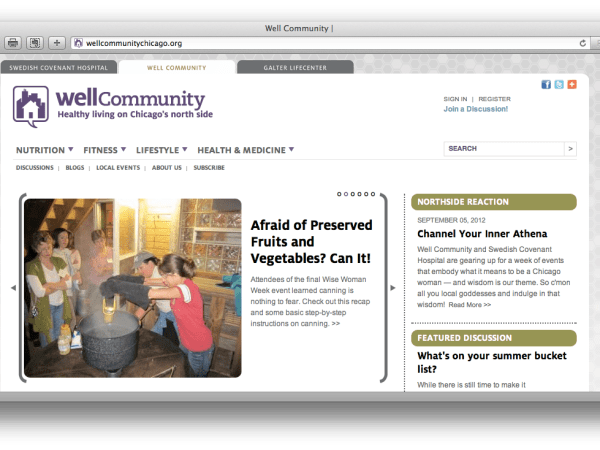
Attendees of the final Wise Woman Week event learned canning is nothing to fear
Nearly two-dozen people packed into the back room of the Peterson Garden Project Learning Center Monday night for a class on canning. The event marked the first official class to take part in the facility, which opened in April. It was also the final event of Swedish Covenant Hospital’s Wise Woman Week.
Laura Scott of Ukrainian Village said she attended the class because, “I grew up on a farm until I was ten and I wanted to get back to my roots.”
The majority of participants—whose experiences spanned the gamut of canning—admitted to being afraid of the time-honored, end-of-summer ritual either because they felt it was too complicated, or that they would do it wrong and waste the food.
LaManda Joy, the founder and president of the Peterson Garden Project, author of the gardening blog TheYarden.com and host for the evening, reassured the women that canning is safe, fun, cost-effective and healthy.
“People are so afraid of not being perfect in today’s world and it makes me sad,” said Joy. “Canning is easy. Don’t be scared, just try it.”
After giving a brief history of canning and an overview of veggie preserving traditions, Joy passed out sample of her canned piccalilli and spicy pickles. She walked through the basics needed for canning and then had attendees participate in a demonstration on proper technique. The women took turns boiling jars, doling out the preserved foods and checking to ensure lids had sealed.
They left the event with pint- and half-pint-sized canning jars and the confidence to try canning at home.
Here are some basic how-tos on pickling from Joy, who draws most of her knowledge from her well-worn cookbook: The Joy of Pickling by Linda Ziedrich.
Basic Ingredients:
- Whatever you’re pickling.
- Salt. Canning & pickling salt is the best for this process. If you can’t find that, try kosher salt, but be aware that you’ll need to adjust your measurements from the recipe.
- Vinegar. You can use various kinds, from rice vinegar, to apple cider vinegar, to Heinz Pickle Perfect, to Gruken Meister (which works great for “quickles”). As long as the vinegar has an acidity of 5% you’ll be fine.
- Water.
- Spices.
Basic Tools:
- Glass jars. Can be half pint or pint in various shapes. These can be reused each season as long as the lids fit securely and there are no chips or cracks.
- Lids. You buy these in bulk and get them new every season.
- Rings. This is what screws onto the lid. These can also be reused each season.
- Large mits. To protect your arms from the scalding water and hot glass.
- Long tongs. Best when they have rubber on the tips.
- Jar funnel. You need one that fits the size of the jar.
- Jar lifter. To remove jars from the boiling water
- Magnetic lid lifter. To keep lids sanitized while canning.
- Canning rack. To sit the jars on in the boiling water.
- Canner. Can be water, steam or pressure based. You can also use a large stockpot if you’re just starting out and want to try canning a few jars.
- Non-reactive pot. To cook the ingredients being canned. Glass, stainless steel, ceramic, or a hard anodized aluminum, like All-Clad, will all work.
- Jar wrench or key. To open your sealed goodies once you’re ready to eat them. It’s the bottle opener for cans.
Joy’s tips on the canning process:
First, follow whatever recipe you’ve chosen for the ingredients you are canning. You can also get creative, adding woody herbs like thyme, rosemary or sage to vegetables being canned, or star anise into jarred fruits.
Sterilize the jars by placing them in a pot of boiling water for 10 minutes. Be sure the jars are not touching each other. Remove the jars with tongs, drain the water from them, and place them on a towel or tray. Never place them on a cold countertop, or the glass could break.
Fill the jars with your delicious ingredients using your funnel. Allow for ½ inch headroom at the top of each jar. Wipe the outer rim of each jar with a hot towel to ensure all food particles are removed and the jar is clean. Lightly bang each jar down on the towel to remove any excess air bubbles. Put the lid and the ring on the jar.
Then place the filled jars back into the boiling water—you can do this one at a time—and make sure there’s enough water in the pot to cover the top of the jars. Water will evaporate as you boil, so to replace the lost water, add in water from your tea kettle. You’ll see bubbles coming out of the jar as the heat interacts with the headroom and the rubber seal. Leave the jars in the water for the length of time specified by your recipe. Make sure the jars are not touching each other while in the water.
Next, use the jar lifter to safely remove each jar and place it back on the towel or tray used before. Once you have them out of the water, listen for the metallic popping sound of the lid being secured. This may take a minute or two.
To test out if the jar is properly sealed, push down on the center of the lid. If you don’t hear a sound, you have a successfully sealed can, which can sit in your pantry from one-to-three years. If you still hear a popping sound, give in another minute to see if it sets itself. If not, place that can in the fridge and eat it within the next few weeks.
Finally—the best part—whenever you’re ready for a little bit of goodness, dive into your favorite jar of canned goods and enjoy!
The Peterson Garden Project is a volunteer organization committed to teaching people to grow their own food.
Heidi Lading is a freelance writer in Chicago.
Photo credit to Heidi Lading
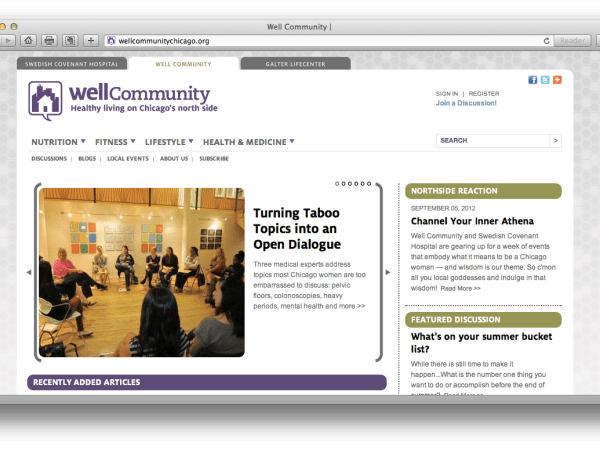
Three medical experts address topics most women are too embarrassed to discuss
You probably know people who’ve thrown out their back or pulled a hamstring, but did you know it’s possible to throw out your pelvic floor muscle?
That little nugget was one of the many fascinating facts gleamed by attendees at a Girl Talk: Shhhh! Ten Taboo Topics event on Thursday night, where participants had the opportunity to bring up health concerns they may otherwise keep to themselves. The women wrote down anonymous questions that were answered by a panel of medical experts. The event was part of Swedish Covenant Hospital’s Wise Woman Week and took place at Flourish Studios.
The discussions about pelvic health didn’t stop at muscle pulls; the women—most of whom were meeting for the first time—delved into details about incontinence, bowel control, sexual function and beyond. The evening’s panelists, women’s health physicians and specialists, fielded the questions with ease and not so much as a blush.
“It’s just like any other muscle,” said Dr. Shameem Abbasy a urogynecologist at Swedish Covenant Hospital who specializes in pelvic floor disorders. “If you injure it or have problems, like leaking urine, there are pelvic floor physical therapists who can help.”
She explained to the group that three sets of 12 Kegel exercises daily may help to strengthen the pelvic floor muscles. But she warned that it is very important to work the right muscles during the exercises.
“I often see patients who are pushing and straining when doing a Kegel, and that’s not what you want to do,” Dr. Abbasy said.
For more advanced pelvic floor muscle training or help activating the right muscles, she recommended the Total Control class at Galter LifeCenter or making an appointment with a urogynecologist or pelvic floor physical therapist.
From there, the group’s conversation transitioned to digestion concerns and periods.
Dr. Kavita Singh, a gastroenterologist at Swedish Covenant Hospital, fielded questions about Celiac Disease, colonics, colonoscopies, constipation, hemorrhoids, Irritable Bowel Syndrome and functional bowel disorders. She explained that all of these conditions are very common among women and nothing to be embarrassed about.
For people worried about discomfort during a colonoscopy, she emphasized that this life-saving procedure is worth a few hours (or days) of possible cramping afterward. The procedure is an examination of the colon and the opportunity for polyps growing in the colon to be removed.
“One-third of the population makes polyps, but there are no symptoms,” she said. “You can have a large polyp in early or advanced stage cancer and never feel it.”
She recommends a first colonoscopy at age 50 unless there is a immediate family history (parent, grand-parent, or sibling) of colon cancer, in which case you should begin at age 40 or 10 years earlier than when your relative was diagnosed—whichever comes first.
Regarding the increasingly trendy colonic procedure, Dr. Singh recommended staying away from them. “I don’t recommend colonics because the body already has a natural method for cleaning itself in one specific direction.”
When asked about methods to lessen or control heavy bleeding during a period, Dr. Abbasy discussed endometrial ablation, a procedure where the uterus lining is thinned.
“It’s a good option for people who don’t want to undergo a full hysterectomy,” said Dr. Abbasy.
Treating the Mind and Changing Behaviors
With many bodily functions and concerns covered, the conversation switched to a topic that women too often ignore: mental health.
Dr. Julia Rahn, a psychologist and owner of Flourish Studios, addressed questioned about Bipolar disorder, “crazy thoughts,” depression and the therapy process.
She encourages people feeling anxious or experiencing insomnia to start with a few minutes of writing and deep breathing.
“Take a journal, don’t edit yourself, get it all out,” she said. “Most people immediately feel better once they’ve done that.”
If a person wants to explore counseling or therapy, Dr. Julia recommended looking for a therapist who will “listen and recommend changes,” and not one that insists on “telling you what to do.”
Missed the Event? No problem.
Dr. Abbasy and Dr. Singh host talks like this two-to-three times a year to grateful crowds, so watch for updates about future Taboo Topic events.
Participant Danielle Washington of Lakeview appreciated the “free forum to ask anything and not feel judged.”
Her friend Jasmine Sayeh of Lakeview said she was leaving the event with “lots of good information.”
Flourish Studios is a multi-faceted learning gallery in Lincoln Park, which motivates and prepares adults, teenagers, and children to bring about significant, self-selected life changes.
Heidi Lading is a freelance writer in Chicago.
Photo credit to Heidi Lading

Well Community was an online news magazine and discussion forum specifically focused on health and wellness in several North side of Chicago neighborhoods. It ceased publication in 2014.


 Heidi (Lading) Kiec, Freelance Corporate Copywriter