Posts from the ‘Chicago’ Category

CEOWorld Magazine, CEO Lifestyle Section, May 4, 2015
Information Enablement: The Critical Factor in Growing Market Share
As a leader in a competitive industry, you are tasked with increasing your market share and growing revenue. The clock is counting down and you feel the constant pressure to achieve this year’s goal. Winning means outselling and outsmarting your competition day-in and day-out.
To bring home that win, you must ensure your customers and prospects understand the “total value” of your products and services. That means everything about your products and services, including not only how they address each customer’s specific needs but also how they enable all customers to remain informed as your offerings change or evolve.
If you or your CEO were in every sales meeting, it stands to reason that your customer’s understanding–or “perceived value”–of your products and services would be pretty close to the total value you hope to convey. If only you could find a way to be in all of those meetings, you would win against the competition almost every time.
But you are not in every meeting. Instead you rely on a large sales organization, which is likely several levels removed from your day-to-day visibility and involvement. As the company’s vision and product visions get batted about through various teams and tools, the value of those messages becomes more and more diluted. And it is not uncommon for your message to become lost entirely on its journey down the “information pipeline” from vision to product marketing to sales tools to sales rep to customer.
Leaders who are unable to meet their strategic objectives are typically the ones experiencing a debilitating loss of perceived value of their products and services. This loss can be traced to one culprit: a weak information pipeline.
How much of this scenario sounds familiar?
Your marketing team puts together product messaging and creates intellectual property that feeds all sales and marketing collateral. Typically the end result is a rigid package of content; a PowerPoint presentation, a few videos, additions to the website, PDF. documents, mini apps, etc. These assets are dull and moderately effective. They are setting your sales force up for failure, which puts your company’s strategic objectives on the line.
So how do you create a strong information pipeline?
In my position as CEO of Mediafly, I have worked with hundreds of people in leadership positions at Fortune 500 companies. They have no trouble explaining to me why their innovative products, services, and strategic initiatives set them apart from and above their competition. But when I ask them how accurate and effective their sales force is at delivering this constantly evolving vision, these leaders become uncomfortable. Why? Because most senior leaders do not have a clear method to gauge their information enablement effectiveness.
Once these leaders understand that information enablement is a critical component of their company’s strength and success–as important as a P&L statement, balance sheet, and cash flow–they start to think differently. They start to understand the direct and inalienable link between information and revenue; information and market share; information and sales.
What is the difference between content and information?
Content is more often than not, created with a specific receiver or audience in mind and can therefore only be used when speaking with that intended recipient. On the other hand, some content is generic enough to apply to multiple audiences, but it doesn’t go deep enough to resonate with any of them. If you send your sales force out with convoluted content, they become ineffective the moment the buyer takes the conversation in an unexpected direction. The battle is lost right then and there.
Information, on the other hand, can be shaped on the spot. It flows from conception to audience without losing any of its meaning. Whether your company is launching a new product, or you need to position yourself against a competitor, your company’s information needs to be delivered quickly and accurately–by hundreds or thousands of sales people day-in and day-out.
Today’s Buyers Demand and Expect More
The companies leading the pack in their respective industries have leaders who embrace the fact that in order to meet their ambitious revenue and market share objectives, they must fully convey–to somebody responsible for purchasing their product or your service–what the product or service does for that prospect’s particular situation. Customers don’t buy products. They buy solutions to their problems. They buy proven success.
Enlightened leaders do not cannibalize on their success by attempting to convey their message through rigid packages of content. In fact, they do not focus on content at all. Instead, they focus on the pure translation and dissemination of the company’s information.
Think of it like this. If content is a pixel, information is the full spectrum of colors. It can be combined and melded together to make any color variation you want. Information is literally and figuratively fluid, and the ability to move it around without rigid boundaries is what makes it so dynamic. You and your leadership teams are constantly refining this full spectrum of colors, but again, you are not always the one with boots on the ground doing the selling. You are not always the conduit through which the company’s vision is conveyed. In fact, you are probably time zones and organizational levels removed from your frontline sales force. Your sales force is fighting to achieve your market share and revenue goals through hand-to-hand combat.
An empowered sales force has the information they need to best position your products and services, regardless of the audience. All without any loss of value. That, my friends, is information enablement.
**********************
Written by Carson Conant*, CEO and Founder of Mediafly, Inc., a globally recognized enterprise software company, that delivers mobile enablement solutions on the Content Mobility Cloud™, for Fortune 100 companies and beyond.
*ghostwritten by Heidi Kiec

Chicago Health Magazine, Winter/Spring 2015 print edition
Thyroid Cancer on the Rise
Diagnosis increasing, but many questions left unanswered
By Heidi Kiec
When Rebecca Smith felt a lump on her neck the Friday of Memorial Day weekend in 2013, she spent the next three days being paranoid that it was lymphoma.
“When I found out I had papillary thyroid cancer, it was a relief to me,” says Smith, who because of her career in healthcare, asked that her name be changed to not draw unnecessary attention to her situation. She admits that the cancer diagnosis was still scary, but she had watched two friends go through papillary thyroid cancer and knew that the prognosis was very good.
Ranking as the fifth leading cancer in women diagnosed in 2014, thyroid cancer has an overall five-year survival rate of 98 percent. About eight out of 10 thyroid cancers are papillary cancers, which are rarely fatal.
In the United States, diagnosis rates for thyroid cancer from 2006 to 2010 increased 5.4 percent in men and 6.5 percent in women, cementing its place as the most rapidly increasing cancer in the country. The American Cancer Society estimated 62,980 people would be diagnosed with thyroid cancer in 2014, and an estimated 1,890 deaths were expected. Of those new cases, three out of four would be women.
Much is still unknown about thyroid cancer including why the diagnosis levels are increasing and why it targets women more than men.
Raymon Grogan, MD, director of the Endocrine Surgery Research Program at the University of Chicago Medical Center calls it “a mystery to the medical community.”
“Certainly some of the rise in thyroid cancer is due to increased detection either through imaging or on pathologic diagnosis; it’s undeniable,” Grogan says. “But the question [remains], is its entire rise due to increased detection? That’s not really as clear.”
Some critics feel there’s been an overdiagnosis or overtreatment of thyroid cancer. But in the United States, there is no national screening program for thyroid cancer, so the majority of thyroid nodules unintentionally discovered by imaging are known as incidentalomas—tumors found incidentally through imaging tests like CT scans or neck ultrasounds, done for reasons unrelated to thyroid dysfunction. The increased use of these refined ultrasounds and imaging techniques may account for an increase in papillary thyroid cancer diagnoses, but it’s debatable whether that’s the only reason for the growing numbers.
Grogan points to an increase in large tumors, like Smith’s, an increase in metastasis to lymph nodes in the neck as well as to distant metastatic diseases outside the neck. That may point to a reason other than an increase in technology’s ability to detect more tumors.
“Another possibility is that there is an unknown environmental factor that is somehow changing the biology of the thyroid cancer itself and is causing an increase in the incidence, but currently there is no definitive proof of that hypothesis” Grogan says. “It is also important to note that the debate over why thyroid cancer rates are increasing is overshadowing a more pressing concern; namely, what to do about these small, seemingly innocuous thyroid cancers that are being diagnosed more frequently. It is likely that not all of them need aggressive treatment like surgery, but we have no way of knowing which are the indolent versus aggressive cancers. For physicians and patients, this is a more urgent question to be answered.”
The scientific community is currently stumped as to what those possible environmental factors are, but research is being conducted on a variety of topics.
“We have to be really careful calling things ‘overdiagnosed,’ because we don’t know, until we reach the point of knowing more about every kind of thyroid cancer, which ones can just be watched,” says pathologist Carey August, MD, at Advocate Illinois Masonic. “It can be misleading for the public when they are told these cancers are being overtreated because then people become hesitant to be appropriately evaluated and to receive what is currently considered to be the appropriate therapy.”
Autopsies often find that people had thyroid cancer at the time of their death, although the cancer was never diagnosed or caused any problems. The findings lead some to believe that treatment paradigms should be changed.
To diagnose thyroid malignancies, pathologists read slides from fine needle aspiration biopsies. In some cases, the diagnosis of a cancer is certain. In other cases, the pathologist reports a designation that indicates the magnitude of risk of cancer in the patient’s thyroid. If a patient does, in fact, have a thyroid cancer, the risk of death may be related to etiology (cause), the molecular underpinnings of the lesion, patient’s age or even gender, August says.
While papillary carcinomas have a high survival rate, there are multiple subtypes with different rates of aggressiveness. “You can’t necessarily tell from a fine needle aspiration which tumors will be deadly,” August says.
Some patients can be watched and have frequent ultrasounds, while those with a concern for malignancy are recommended for lobectomies, a partial removal of the thyroid lobe, or thyroidectomies, removal of the entire thyroid.
“Once a pathologist has either a lobe of the thyroid with the tumor in it, or the whole thyroid with the tumor in it, we can identify the aggressive variants,” August says.
Smith’s case is somewhat unique because she felt a lump in her neck and sought out a diagnosis. She went through a series of ineffective diagnosis procedures and inconclusive results, she says, before finding her way to Northwestern Memorial Hospital, where a thyroid surgeon immediately informed her that there were two nodules on her thyroid.
“I’d had five people feel my neck, and not one of them said that. Why? Nobody knew,” Smith says.
“It’s not common to have symptoms for thyroid cancer,” says Anthony Yang, MD, a surgical oncologist at Northwestern Medicine who did not treat Smith. “A lump in the neck is the most common symptom, but often people have no symptoms, and a tumor has been detected some other way.”
Yang, Grogan and August all agree that the best advice for a thyroid cancer patient is to go to a center where thyroid cancers are seen and treated regularly, if not exclusively.
Smith had two small tumors on her thyroid and one large metastasized tumor not on her thyroid. She underwent a thyroidectomy and right neck dissection.
She remembers her surgeon’s macabre pep talk: “This will not kill you. You will die years and years from now from something else.” She’s part of the 98 percent survival rate, but that didn’t make her recovery any easier.
Smith spent several months physically and emotionally adjusting to the thyroid hormone supplements, which are now a daily lifelong ritual because of her thyroidectomy and the radioactive iodine treatment she underwent a few months after surgery. Radioactive iodine is another big controversy in the world of thyroid cancer; it’s extremely effective but makes the patient radioactive for a short period of time and, in higher doses, can cause cancer.
The questions about thyroid cancer linger, and the debates rage on. Even though the reason for the cancer’s increase is unclear, the outlook for patients with thyroid cancer is generally good. As far as Smith is concerned, she’s happy her treatment has been successful, and she’s glad to be moving on with her life. +

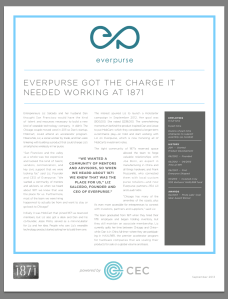
Client: Chicagoland Entrepreneurial Center (CEC) / 1871
CEC’s situation: Gearing up for its annual Momentum Awards fundraising dinner, the CEC needed to assemble a slick packet of information touting their past 12 month’s accomplishments to generate sponsors for the big event. Several startup companies recently grew out of their co-working digs at the CEC’s tech startup hub, 1871, and into their own office spaces. The CEC wanted to profile these “graduates” to drum up sponsorship dollars.
My solution: The founders of the startups were also being interviewed on camera for a video that would run during the awards dinner, so I coordinated schedules with the video producers and the CEOs and conducted my own round of off-camera interviewing. I identified relevant pull-quotes, and important facts/figures for the graphic designer to layout in the sidebar of each one-pager.
The result: I’ve done freelance writing for the CEC since before 1871 launched, so I was well versed in the tone and style they wanted. My relationship with the tech hub also meant I knew what angles to highlight for each startup to best position the companies and 1871 to pull in the sponsorship dollars.
Click the images below to view each one-pager.




 Heidi (Lading) Kiec, Freelance Corporate Copywriter