Posts tagged ‘Health & Wellness’
Chicago Health Magazine, Winter/Spring 2015 print edition
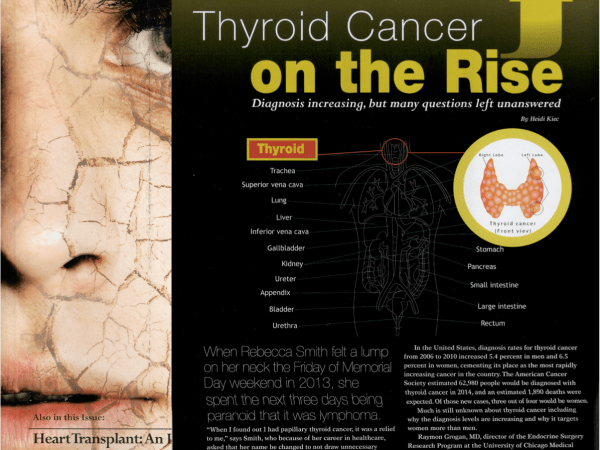
Thyroid Cancer on the Rise
Diagnosis increasing, but many questions left unanswered
By Heidi Kiec
When Rebecca Smith felt a lump on her neck the Friday of Memorial Day weekend in 2013, she spent the next three days being paranoid that it was lymphoma.
“When I found out I had papillary thyroid cancer, it was a relief to me,” says Smith, who because of her career in healthcare, asked that her name be changed to not draw unnecessary attention to her situation. She admits that the cancer diagnosis was still scary, but she had watched two friends go through papillary thyroid cancer and knew that the prognosis was very good.
Ranking as the fifth leading cancer in women diagnosed in 2014, thyroid cancer has an overall five-year survival rate of 98 percent. About eight out of 10 thyroid cancers are papillary cancers, which are rarely fatal.
In the United States, diagnosis rates for thyroid cancer from 2006 to 2010 increased 5.4 percent in men and 6.5 percent in women, cementing its place as the most rapidly increasing cancer in the country. The American Cancer Society estimated 62,980 people would be diagnosed with thyroid cancer in 2014, and an estimated 1,890 deaths were expected. Of those new cases, three out of four would be women.
Much is still unknown about thyroid cancer including why the diagnosis levels are increasing and why it targets women more than men.
Raymon Grogan, MD, director of the Endocrine Surgery Research Program at the University of Chicago Medical Center calls it “a mystery to the medical community.”
“Certainly some of the rise in thyroid cancer is due to increased detection either through imaging or on pathologic diagnosis; it’s undeniable,” Grogan says. “But the question [remains], is its entire rise due to increased detection? That’s not really as clear.”
Some critics feel there’s been an overdiagnosis or overtreatment of thyroid cancer. But in the United States, there is no national screening program for thyroid cancer, so the majority of thyroid nodules unintentionally discovered by imaging are known as incidentalomas—tumors found incidentally through imaging tests like CT scans or neck ultrasounds, done for reasons unrelated to thyroid dysfunction. The increased use of these refined ultrasounds and imaging techniques may account for an increase in papillary thyroid cancer diagnoses, but it’s debatable whether that’s the only reason for the growing numbers.
Grogan points to an increase in large tumors, like Smith’s, an increase in metastasis to lymph nodes in the neck as well as to distant metastatic diseases outside the neck. That may point to a reason other than an increase in technology’s ability to detect more tumors.
“Another possibility is that there is an unknown environmental factor that is somehow changing the biology of the thyroid cancer itself and is causing an increase in the incidence, but currently there is no definitive proof of that hypothesis” Grogan says. “It is also important to note that the debate over why thyroid cancer rates are increasing is overshadowing a more pressing concern; namely, what to do about these small, seemingly innocuous thyroid cancers that are being diagnosed more frequently. It is likely that not all of them need aggressive treatment like surgery, but we have no way of knowing which are the indolent versus aggressive cancers. For physicians and patients, this is a more urgent question to be answered.”
The scientific community is currently stumped as to what those possible environmental factors are, but research is being conducted on a variety of topics.
“We have to be really careful calling things ‘overdiagnosed,’ because we don’t know, until we reach the point of knowing more about every kind of thyroid cancer, which ones can just be watched,” says pathologist Carey August, MD, at Advocate Illinois Masonic. “It can be misleading for the public when they are told these cancers are being overtreated because then people become hesitant to be appropriately evaluated and to receive what is currently considered to be the appropriate therapy.”
Autopsies often find that people had thyroid cancer at the time of their death, although the cancer was never diagnosed or caused any problems. The findings lead some to believe that treatment paradigms should be changed.
To diagnose thyroid malignancies, pathologists read slides from fine needle aspiration biopsies. In some cases, the diagnosis of a cancer is certain. In other cases, the pathologist reports a designation that indicates the magnitude of risk of cancer in the patient’s thyroid. If a patient does, in fact, have a thyroid cancer, the risk of death may be related to etiology (cause), the molecular underpinnings of the lesion, patient’s age or even gender, August says.
While papillary carcinomas have a high survival rate, there are multiple subtypes with different rates of aggressiveness. “You can’t necessarily tell from a fine needle aspiration which tumors will be deadly,” August says.
Some patients can be watched and have frequent ultrasounds, while those with a concern for malignancy are recommended for lobectomies, a partial removal of the thyroid lobe, or thyroidectomies, removal of the entire thyroid.
“Once a pathologist has either a lobe of the thyroid with the tumor in it, or the whole thyroid with the tumor in it, we can identify the aggressive variants,” August says.
Smith’s case is somewhat unique because she felt a lump in her neck and sought out a diagnosis. She went through a series of ineffective diagnosis procedures and inconclusive results, she says, before finding her way to Northwestern Memorial Hospital, where a thyroid surgeon immediately informed her that there were two nodules on her thyroid.
“I’d had five people feel my neck, and not one of them said that. Why? Nobody knew,” Smith says.
“It’s not common to have symptoms for thyroid cancer,” says Anthony Yang, MD, a surgical oncologist at Northwestern Medicine who did not treat Smith. “A lump in the neck is the most common symptom, but often people have no symptoms, and a tumor has been detected some other way.”
Yang, Grogan and August all agree that the best advice for a thyroid cancer patient is to go to a center where thyroid cancers are seen and treated regularly, if not exclusively.
Smith had two small tumors on her thyroid and one large metastasized tumor not on her thyroid. She underwent a thyroidectomy and right neck dissection.
She remembers her surgeon’s macabre pep talk: “This will not kill you. You will die years and years from now from something else.” She’s part of the 98 percent survival rate, but that didn’t make her recovery any easier.
Smith spent several months physically and emotionally adjusting to the thyroid hormone supplements, which are now a daily lifelong ritual because of her thyroidectomy and the radioactive iodine treatment she underwent a few months after surgery. Radioactive iodine is another big controversy in the world of thyroid cancer; it’s extremely effective but makes the patient radioactive for a short period of time and, in higher doses, can cause cancer.
The questions about thyroid cancer linger, and the debates rage on. Even though the reason for the cancer’s increase is unclear, the outlook for patients with thyroid cancer is generally good. As far as Smith is concerned, she’s happy her treatment has been successful, and she’s glad to be moving on with her life. +
The Center for Cancer and Blood Disorders at Phoenix Children’s Hospital (Website Copywriting)
Project
Client: Phoenix Children’s Hospital (PCH)
PCH’s situation: Phoenix Children’s Hospital had information about its Center for Cancer and Blood Disorders (CCBD) in a variety of places online and they wanted a cohesive microsite that parents of sick children could visit and immediately understand the expertise the PCH CCBD team offered.
My solution: This project was a mixture of writing, editing, and curating content so that every program section within the CCBD microsite had the same tone and presentation of information.
The result: I provided content for nine pages within the microsite, including the Hematology index page and its subsequent program pages: Hemophilia, Sickle Cell Disease, Thrombosis; the Histiocytosis index page; and the following Oncology program pages: Blood & Marrow Transplant, Leukemia/Lymphoma, Neuro-oncology, and Solid Tumor.

Attendees of the final Wise Woman Week event learned canning is nothing to fear
Nearly two-dozen people packed into the back room of the Peterson Garden Project Learning Center Monday night for a class on canning. The event marked the first official class to take part in the facility, which opened in April. It was also the final event of Swedish Covenant Hospital’s Wise Woman Week.
Laura Scott of Ukrainian Village said she attended the class because, “I grew up on a farm until I was ten and I wanted to get back to my roots.”
The majority of participants—whose experiences spanned the gamut of canning—admitted to being afraid of the time-honored, end-of-summer ritual either because they felt it was too complicated, or that they would do it wrong and waste the food.
LaManda Joy, the founder and president of the Peterson Garden Project, author of the gardening blog TheYarden.com and host for the evening, reassured the women that canning is safe, fun, cost-effective and healthy.
“People are so afraid of not being perfect in today’s world and it makes me sad,” said Joy. “Canning is easy. Don’t be scared, just try it.”
After giving a brief history of canning and an overview of veggie preserving traditions, Joy passed out sample of her canned piccalilli and spicy pickles. She walked through the basics needed for canning and then had attendees participate in a demonstration on proper technique. The women took turns boiling jars, doling out the preserved foods and checking to ensure lids had sealed.
They left the event with pint- and half-pint-sized canning jars and the confidence to try canning at home.
Here are some basic how-tos on pickling from Joy, who draws most of her knowledge from her well-worn cookbook: The Joy of Pickling by Linda Ziedrich.
Basic Ingredients:
- Whatever you’re pickling.
- Salt. Canning & pickling salt is the best for this process. If you can’t find that, try kosher salt, but be aware that you’ll need to adjust your measurements from the recipe.
- Vinegar. You can use various kinds, from rice vinegar, to apple cider vinegar, to Heinz Pickle Perfect, to Gruken Meister (which works great for “quickles”). As long as the vinegar has an acidity of 5% you’ll be fine.
- Water.
- Spices.
Basic Tools:
- Glass jars. Can be half pint or pint in various shapes. These can be reused each season as long as the lids fit securely and there are no chips or cracks.
- Lids. You buy these in bulk and get them new every season.
- Rings. This is what screws onto the lid. These can also be reused each season.
- Large mits. To protect your arms from the scalding water and hot glass.
- Long tongs. Best when they have rubber on the tips.
- Jar funnel. You need one that fits the size of the jar.
- Jar lifter. To remove jars from the boiling water
- Magnetic lid lifter. To keep lids sanitized while canning.
- Canning rack. To sit the jars on in the boiling water.
- Canner. Can be water, steam or pressure based. You can also use a large stockpot if you’re just starting out and want to try canning a few jars.
- Non-reactive pot. To cook the ingredients being canned. Glass, stainless steel, ceramic, or a hard anodized aluminum, like All-Clad, will all work.
- Jar wrench or key. To open your sealed goodies once you’re ready to eat them. It’s the bottle opener for cans.
Joy’s tips on the canning process:
First, follow whatever recipe you’ve chosen for the ingredients you are canning. You can also get creative, adding woody herbs like thyme, rosemary or sage to vegetables being canned, or star anise into jarred fruits.
Sterilize the jars by placing them in a pot of boiling water for 10 minutes. Be sure the jars are not touching each other. Remove the jars with tongs, drain the water from them, and place them on a towel or tray. Never place them on a cold countertop, or the glass could break.
Fill the jars with your delicious ingredients using your funnel. Allow for ½ inch headroom at the top of each jar. Wipe the outer rim of each jar with a hot towel to ensure all food particles are removed and the jar is clean. Lightly bang each jar down on the towel to remove any excess air bubbles. Put the lid and the ring on the jar.
Then place the filled jars back into the boiling water—you can do this one at a time—and make sure there’s enough water in the pot to cover the top of the jars. Water will evaporate as you boil, so to replace the lost water, add in water from your tea kettle. You’ll see bubbles coming out of the jar as the heat interacts with the headroom and the rubber seal. Leave the jars in the water for the length of time specified by your recipe. Make sure the jars are not touching each other while in the water.
Next, use the jar lifter to safely remove each jar and place it back on the towel or tray used before. Once you have them out of the water, listen for the metallic popping sound of the lid being secured. This may take a minute or two.
To test out if the jar is properly sealed, push down on the center of the lid. If you don’t hear a sound, you have a successfully sealed can, which can sit in your pantry from one-to-three years. If you still hear a popping sound, give in another minute to see if it sets itself. If not, place that can in the fridge and eat it within the next few weeks.
Finally—the best part—whenever you’re ready for a little bit of goodness, dive into your favorite jar of canned goods and enjoy!
The Peterson Garden Project is a volunteer organization committed to teaching people to grow their own food.
Heidi Lading is a freelance writer in Chicago.
Photo credit to Heidi Lading


 Heidi (Lading) Kiec, Freelance Corporate Copywriter